
The Stone with a Hole: Grief, Thresholds, and the Old Ways
The day after my mother passed away, I took my dogs to the beach.
I had no plan to do so. I am not a beach walker. I belong to the forest — to trees, roots, shade, and soil. Over the years I have stood on that same shoreline dozens of times, passed over its stones, walked it without ceremony or pause.
But that day was different.
That morning, something pulled.
Not emotionally. Not sentimentally.
Physically.
I found myself at Rock Point Provincial Park, on the north shore of Lake Erie, walking the frozen shoreline barefoot. It was just above freezing — three degrees Celsius — and the beach was covered in snow, slush, and ice. Cold freshwater flooded around my feet with every step. There was no comfort in it. No romance.
Only presence.
The cold stripped everything away. Thought narrowed. The body came forward. Grief did not disappear, but it became quieter — focused — as though something else was asking for my attention.
And then I saw it.
One stone.
Out of millions. The entire beach is covered with millions and millions of round, flat stones
Then there was this one.
The Impossibility of Chance
The stone lay among ice-crusted rock and frozen sand, no more visible than any other — except that it was. My eyes went to it immediately, without scanning, without searching.
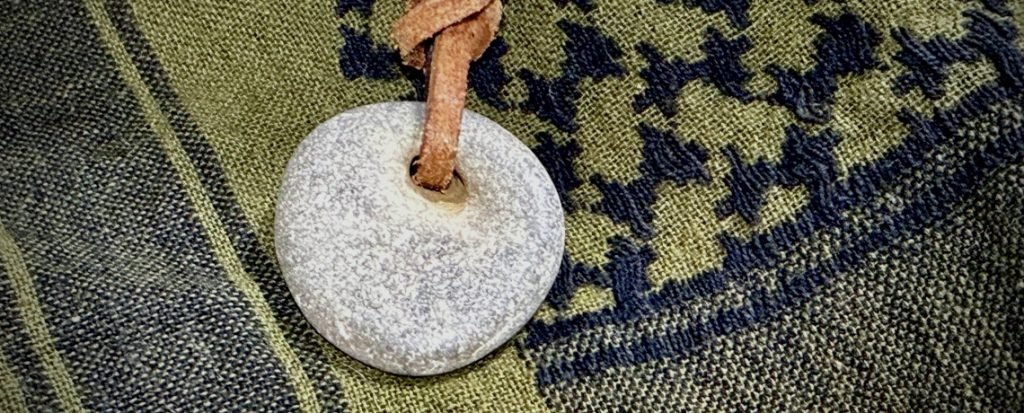
It was round. Smooth. Pale.
And pierced.
Not cracked.
Not drilled.
Not damaged.
A perfectly natural hole, worn by freshwater alone. The opening did not run straight, but wandered slightly — the mark of slow erosion, not force. When I picked it up, the fit was unmistakable. The size. The weight. The balance.
It sat in my hand as though it had been waiting there.
The hole was not only natural — it was placed exactly where it needed to be. Centered enough to hang. Smooth enough to wear. Neither too large nor too small. Not sharp. Not fragile.
It was already a necklace.
This matters.
Because this was freshwater.
Hag stones are rare anywhere, but in freshwater environments they are extraordinarily rare. Lake Erie does not grind stone the way oceans do. Its geology fractures more often than it pierces. To find a naturally holed stone here requires centuries of exact conditions.
And yet here it was.
On the one day I should not have been there.
On the one walk I did not plan.
On a beach I had crossed many times before without ever finding such a thing.
To call that coincidence is to misunderstand how the old world works.
Hag Stones Are Not Found — They Are Given
In Slavic folk tradition, hag stones were never treated as curiosities. They were recognized.
They were believed to be shaped by forces older than any person — water, time, and will — and because of this they were not considered owned, but entrusted.
A hag stone was not luck.
It was protection.
It was sight.
It was passage.
Families kept them for generations. They were hung near doors, tied to cradles, carried by those who traveled or fished or guarded others. When the keeper died, the stone was passed on — not casually, but deliberately.
Because hag stones were rare, they were never wasted.
Because they were rare, they were listened to.
And because they endured, they were associated with those who no longer walked, but still watched.
The Call
I did not go to the beach seeking signs.
But something called me there.
And something called me to that stone.
There is a moment — subtle, but unmistakable — when the world leans toward you. When your body moves before your mind can object. When choice gives way to recognition.
That is what happened.
I picked up the stone without hesitation. I did not debate it. I did not test it. I did not wonder whether it was “special.”
I knew.
Not intellectually — ancestrally.
My Mother and the Line
My mother had passed the day before.
Grief had not yet settled into shape. It was raw, unformed, everywhere. And yet, standing barefoot in freezing water, holding that stone, something steadied.
Not comfort.
Orientation.
In Rodnovery, we speak of rod — the unbroken thread of lineage, the living connection between those who came before us and those who still walk. Death does not sever that thread. It tightens it.
The dead do not vanish.
They reposition.
I do not believe my mother became the stone.
But I do believe she directed me to it.
Not as a miracle.
Not as spectacle.
But as continuity.
She knew the land I walk. She knew the way my body listens before my mind does. She knew I would understand a stone better than words.
A Stone Meant to Be Worn
I brought the stone home and made it into a necklace using a strip of real leather.
I wear it high on my neck, hidden beneath my beard.
No one sees it.
But I feel it often.
When grief rises suddenly, my hand goes to it without thought. The weight is real. The surface is cool. The hole reminds me that even the hardest things are shaped by patience.
This stone is not decoration.
It is a marker.
Of passage.
Of protection.
Of being guided when sight is clouded.
Not Random. Never Random.
One stone.
On a frozen beach.
Among millions.
On the day after death.
At the exact size and shape needed.
Found without searching.
The old world does not speak loudly.
It speaks precisely.
And when it does, coincidence is no longer a sufficient explanation.
The stone was not random.
Neither was I.
And I kept walking.
