
The Day the Forest Spit Wasps at Us
Summer camp was always one of the best experiences. Both for staff, and for the campers. Summer camp was there to build camaraderie, and make amazing memories every day you’re there.
This is a story about one of those days.
At the time, I was working at Heartland Forest as the head counsellor. It was the kind of place where children could step out of the concrete world and back into the trees, where mud was part of the uniform and curiosity was part of the curriculum. My job was to guide the kids, keep them safe, and make sure they left the forest a little more confident, a little more capable, and a lot more connected to the land.
One morning, the director approached me with a practical problem. Someone had spotted a fallen log in the forest that was home to a nest of yellow jackets. The log was near one of the main activity areas, and with campers around, that could become a serious issue. Yellow jackets are not the gentle, mind-your-own-business kind of insects. They’re defensive, aggressive, and very quick to take offense.
The director handed me a can of wasp spray and asked me to go deal with it.
Simple enough, right?
I grabbed two of the volunteers—both young guys, strong, energetic, and full of that particular brand of confidence that only comes from being young and not yet fully acquainted with consequences. We set off down the trail, the forest floor soft beneath our feet, the air thick with the smell of leaves and damp earth.
As always, I was barefoot. It was just how I moved through the woods. Shoes always felt like a barrier between me and the ground, like wearing gloves while trying to shake someone’s hand. Bare feet meant I could feel every twig, every patch of moss, every subtle change in the terrain. It kept me present.
We walked deeper into the forest until we found the log.
It wasn’t particularly impressive at first glance. Just an old, decaying piece of wood lying half-sunken into the leaf litter. But as we got closer, we could see the small, constant movement—tiny yellow bodies slipping in and out of a hole in the side. A yellow jacket nest, tucked safely inside.
I turned to the volunteers.
“Okay,” I said, holding up the can of spray. “We’re going to be careful here. Don’t touch the log. Don’t kick it. Don’t move it. I’ll spray the entrance, and then we’ll back off slowly.”
They nodded.
One of them, though, had that mischievous look in his eye. You know the one. The look that says, I’m thinking about doing exactly the thing you just told me not to do.
He pointed at the log and asked, “What happens if we kick it?”
I looked right at him.
“No,” I said firmly. “Don’t do that.”
The moment the words left my mouth, he grinned, let out a short laugh, and sprinted toward the log.
Before I could even take a step, he wound up and gave it a solid boot.
The log vibrated.
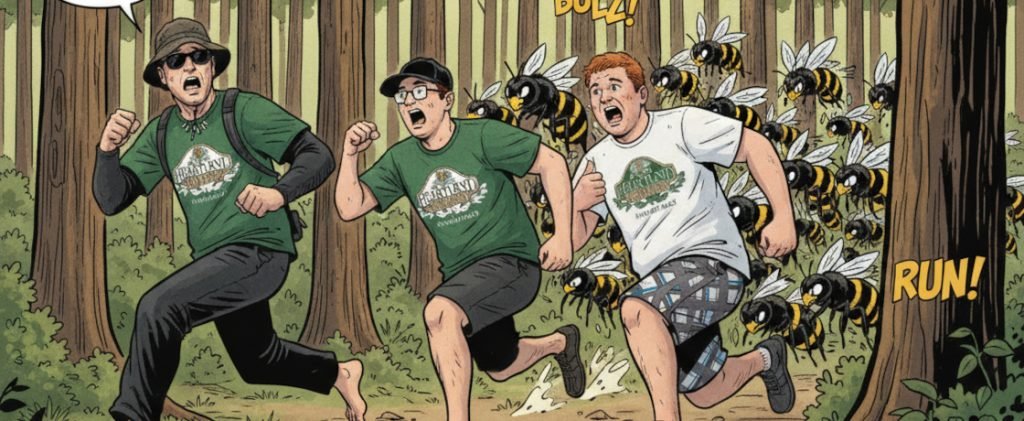
And then, in a moment I can only describe as the forest spitting back at us, the entrance hole erupted. It didn’t just release a few wasps. It was like the log itself exhaled a living cloud of yellow jackets.
They poured out in a buzzing, furious swarm.
For half a second, all three of us just stared.
Then instinct took over.
We ran.
There we were—three of us sprinting through the forest, branches whipping past our faces, leaves crunching underfoot. I still had the can of wasp killer clutched in my hand, completely useless now, like a water pistol in a thunderstorm.
Behind us, the swarm followed, a vibrating, angry cloud determined to defend their home.
We were all laughing.
Not polite chuckles. Not nervous giggles. Full-on, can’t-breathe, tears-in-your-eyes laughter. The kind that only comes from the perfect mix of danger, adrenaline, and absolute absurdity.
The volunteer who kicked the log was ahead of me, glancing back over his shoulder with wide eyes and a grin that said, Okay, that might have been a mistake.
The other volunteer was right beside me, both of us weaving through the trees, trying not to trip over roots or crash into branches.
And me—barefoot, sprinting through the forest, wasp spray in hand, laughing like a madman.
We must have run a good distance before the swarm finally lost interest and drifted back toward their log. We slowed down, breathing hard, still laughing, brushing imaginary wasps off our clothes.
None of us had been stung.
Not one sting.
We stood there in the woods, laughing our heads off while trying to catch our breath.
The volunteer who kicked the log shook his head and said, “Okay… I deserved that.”
I just continued laughing and said, between breaths “Next time someone tells you not to kick something in the forest… there’s probably a reason.”
We made our way back to the main area, a little wiser, a little humbler, and with a much better respect for fallen logs.
Looking back, it’s one of those stories that perfectly captures the spirit of working in the woods with young people. You can plan. You can give instructions. You can try to control every variable. But the forest always has the final say.
And sometimes, it says it with a cloud of yellow jackets.
It was a lesson in respect—for nature, for experience, and for the simple wisdom of listening when someone says, “Don’t kick the log.”
Because sometimes, the log kicks back.
