


🗡️ The Hanwei / CAS Iberia Agincourt Sword — A Woodman’s Review
There’s something timeless about the feel of a well-balanced sword in the hand. Even for someone who spends most days in the forest, teaching archery and fire-making beneath the open sky, the pull of steel and legend never fades. One of the blades that has lived in my collection since the late 1990s is the CAS-Iberia Agincourt Sword, forged by Hanwei in Dalian, China, under the guidance of master bladesmith Paul Chen. After nearly three decades, I thought it was time to give this elegant weapon the tribute it deserves.
I purchased the sword from the Turner Crescent Flea Market vendor known as “B & D Knives and Tools” in the late 1990s. He was a popular vendor at the flea market which was located in St. Catharines, Ontario. A nearby city to where I lived at the time.
⚔️ Remembering the Battle of Agincourt — October 25 1415
Each year on October 25th, I take a quiet moment to remember the Battle of Agincourt, one of the defining clashes of the Hundred Years’ War. On that muddy autumn morning in northern France, King Henry V and his exhausted, outnumbered English army faced thousands of French knights near the village of Agincourt.
What followed was a miracle of discipline and skill. Behind lines of sharpened stakes, English archers unleashed storms of long-bow arrows that tore through French armor and chivalric pride alike. By day’s end, France’s noble ranks were shattered, and Henry’s leadership had become legend.
The victory wasn’t about wealth or numbers; it was about precision, courage, and mastery of one’s craft—the same principles embodied by the Hanwei Agincourt Sword. To which the sword pays tribute.
⚙️ Sword Specifications
| Specification | Details |
|---|---|
| Maker | Hanwei Forge (Paul Chen) |
| Distributor | CAS Iberia |
| Model Number | SH2371 |
| Historical Period | 15th Century – Hundred Years’ War |
| Overall Length | 35¼ in (≈ 90 cm) |
| Blade Length | 27¼ in (≈ 69 cm) |
| Blade Steel | 1566 High-Carbon Steel |
| Blade Profile | Flattened diamond with narrow fuller (thrust-optimized) |
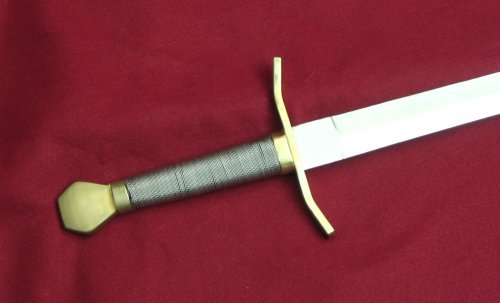
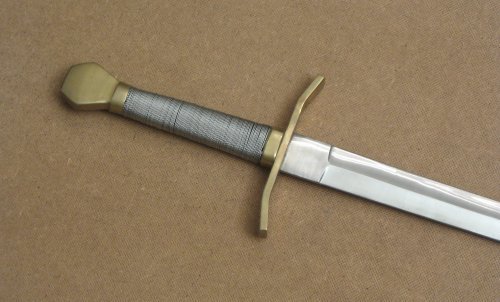
| Handle / Grip | Wood core, wire-wrapped leather (early edition) |
| Guard & Pommel | Brass-coloured steel; faceted “scent-stopper” pommel |
| Weight | ≈ 2 lb 8 oz (1.13 kg) |
| Tang Construction | Full tang, peened |
| Scabbard | Leather-covered wood |
| Country of Origin | China |
| First Release | Mid-to-Late 1990s |
🛠️ Construction & Craftsmanship
The Hanwei Agincourt arrived on the Western market at a time when “decorative” stainless blades ruled the shelves. Paul Chen changed that by introducing functional, heat-treated high-carbon steel into an affordable sword line.
My 1990s edition features the brass-coloured guard and pommel and a fine wire-wrapped grip—features later replaced with plain steel and leather. The octagonal pommel perfectly balances the blade and provides control in half-swording. The full-tang construction and proper peen ensure the hilt remains tight even after years of handling.
At about two-and-a-half pounds, the sword feels agile yet authoritative, light enough for speed and precision but with a reassuring presence.

⚖️ Balance and Handling
The point of balance sits roughly three inches forward of the guard, ideal for a late-medieval one-handed sword. The narrow fuller and diamond cross-section channel strength into the tip, making this a true thrusting weapon—yet still capable of clean cuts through light targets.
It moves naturally, almost intuitively. There’s no struggle to control it—only the feeling of extension and flow. The Agincourt is a perfect example of how the European arming sword evolved for armored warfare: focused, precise, and efficient.
🎨 Aesthetics and Presence
The sword’s appearance reflects quiet nobility. The golden fittings catch soft light beautifully, while the wire wrap lends a medieval authenticity seldom seen in production blades. Over time, the brass has aged into a mellow patina, deepening the weapon’s character.
There’s no need for etched dragons or mirror polish here—just honest steel and balanced lines. It’s the kind of sword that looks equally at home on a castle wall or resting against a log in camp.
🧰 Scabbard and Accessories
The original scabbard is straightforward: leather over wood, durable stitching, and a snug fit. After decades, mine remains intact and serviceable. Later Hanwei editions added steel chapes and throats, but I prefer the early simplicity—it complements the weapon’s restrained style.
🏕️ Field Impressions
I’ve used this sword on rolled mats, saplings, and light targets. It cuts cleanly, flexes back true, and shows no signs of fatigue. The grip remains solid, and the peen secure after years of casual practice.
Its proportions make it ideal for one-handed drills or paired work with a buckler. For re-enactors or martial artists seeking a reliable training companion, it delivers exceptional value and authenticity.
🧙♂️ Collectability and Legacy
The early brass-fitted, wire-wrapped Agincourt is now considered a collectible piece of Hanwei history. It marks the forge’s transition from decorative to functional swordmaking. Collectors appreciate its mix of strength, beauty, and accessible price—qualities that helped revolutionize the sword market.
Even after thirty years, my blade remains tight and true, a testament to the forge’s consistency and craftsmanship.
🌲 Reflections from the Forest
There’s something poetic about drawing this sword in the stillness of a pine forest, huskies watching, mist swirling between the trees. The Agincourt represents more than just steel—it embodies endurance, skill, and connection to heritage.
When I recreated the image of pulling it from the stone, it wasn’t fantasy. It was gratitude—for the timeless artistry of the smith, for the legacy of October 25th, 1415, and for the reminder that simplicity and mastery still matter in a world that moves too fast.
The English archers at Agincourt won through discipline and resourcefulness. Those same virtues guide anyone who walks the wild barefoot, crafting fire, or mastering a blade.
⚒️ Final Thoughts
The Hanwei / CAS Iberia Agincourt Sword remains one of the finest practical reproductions of a 15th-century arming sword. It’s light, balanced, and faithful to history—equally suited for collectors, martial artists, and those who simply appreciate good craftsmanship.
This October 25th, as I stand beneath the pines with the sword in hand, I remember the men who fought in the mud of northern France six centuries ago—and the spirit that endures whenever a craftsman creates something honest, functional, and beautiful.
📜Source
Some of the information in this blog has been sourced at the Ed – Arms & Armor page Copyright © Ed T. Toton III, All Rights Reserved.
https://ed.toton.org/weapons/casiberia-agincourt.html