
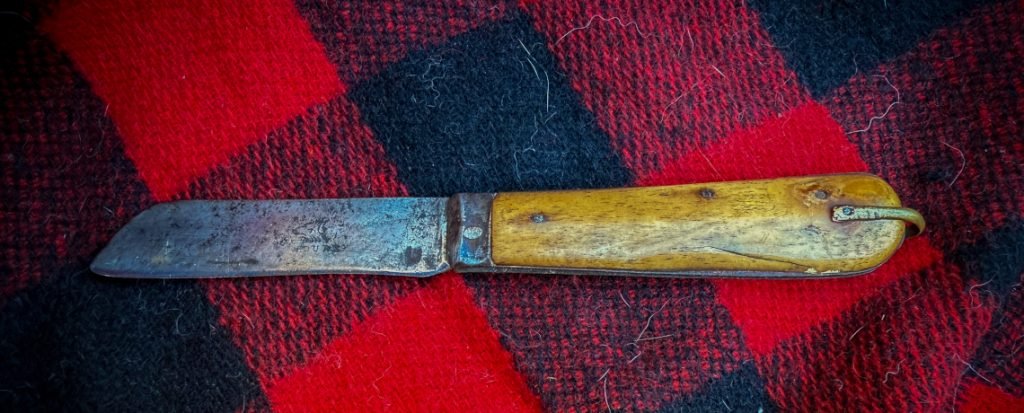

This folding knife, once held by my grandfather and now resting in my pack beside the fire, bears the stamp of “Joseph Beal & Sons – Sheffield.”
The knife would have been purchased by my grandfather, Jozef Telega when he was at the Tommyfield Market in Oldham, England sometime in the late 1940’s before he moved to Canada in the mid 1950s.
It dates back to an era when Sheffield’s furnaces and grinding wheels forged blades that travelled the world — from the tables of English households to the belts of hunters, soldiers, and tradesmen across the colonies. As I trace the wear on its handle and open the steel hinge with my bare fingers, I’m reminded of the continuity of craft: the same metal edge that served earlier generations now serves me in my outdoor work, rooted in ancestral practice and bush-skill tradition.
The Legacy of Sheffield Steel
Sheffield steel was once a name that needed no introduction. In the 1800s, it stood alongside Damascus and Solingen as a hallmark of excellence. The men of Sheffield didn’t just make knives — they forged character into metal. Their work was known for resilience and balance, and for a clean edge that could hold its temper through years of honest use. So respected was that name that even Doctor Who — a show set in the far reaches of time and space — referenced “Sheffield steel” as strong enough to forge the Doctor’s own sonic screwdriver.
To carry a Sheffield-made knife was to carry a piece of history — the product of smoke, muscle, and skill. Every one was made by a craftsman who knew what it meant to shape the world by hand.
The Maker: Joseph Beal & Sons
Among the great Sheffield firms was Joseph Beal & Sons, whose name is stamped faintly on the spine of my grandfather’s blade. The Beal family worked from the early 1800s, producing everything from butcher knives to folding pocket tools. Their mark — sometimes accompanied by the word “Endure” — became known for sturdy working blades that stood the test of time.
Unlike the ornate pieces made for display, Beal’s knives were built for use. They found their way into the hands of tradesmen, farmers, and soldiers — men who needed something reliable when the work was hard and the days were long.
The knife in my possession likely dates to the late 19th century, made when Sheffield’s forges still thundered and sparks from the grinding wheels filled the night. The handle is made of polished bone, its honeyed patina earned through years of work and handling. A small brass loop at the end suggests it was meant to hang from a belt — practical, simple, and humble, like the men who used it.

A Man’s Companion
My grandfather was born in 1927 in Poland. He fought in the Second World War, lived through a world reshaped by chaos, and later settled in England. He came from an era where every man who was a man carried a pocket knife — not as a weapon, but as a companion.
A knife was a tool for mending, carving, cutting rope, or sharing bread. It was a symbol of readiness and self-reliance. In the old world, a man without a knife was like a craftsman without his hands. That simple tradition — to always carry a blade — spoke of independence, responsibility, and the quiet pride of being prepared.
When I hold this knife, I imagine him as a young man, the smell of machine oil and smoke around him, the sound of old English factories and train stations, his hand finding comfort in the familiar weight of the blade in his pocket.
Steel, Bone, and Bloodline
The knife’s steel may have been forged in England, but the hands that carried it were Polish — hands that knew struggle, survival, and endurance. It’s a perfect symbol of blended heritage: the toughness of Sheffield metal meeting the tenacity of Eastern blood.
Over time, the bone handle absorbed the oils from his hands. The blade took on the marks of use — scratches, stains, and the subtle darkening that only decades can bring. These
Enduring Craft
Today, I carry this knife not as a relic, but as a living tool. It sits beside my modern blades in the kit I use for bushcraft and outdoor teaching. I take care to oil it lightly and keep its hinge moving freely, but I resist the urge to polish away its age. Patina is memory made visible.
In a world obsessed with disposable tools, this knife reminds me of the era when things were made to last. When a blade wasn’t just steel, but trust.
Closing Reflection
When I open my grandfather’s knife beside the fire, I see more than the reflection of the flame on the blade — I see the reflection of the man himself. His generation lived by endurance and craft, by hands-on work and quiet pride. I like to think that somewhere in that Sheffield steel is a spark of his spirit, still enduring, still cutting through time.
So I keep the knife close — not locked away, but carried and used — as it was meant to be. A simple tool, a memory made tangible, and a reminder that true craftsmanship, like true character, doesn’t fade. It endures.
are not flaws; they’re fingerprints of history. Each scar tells a story. Each nick in the edge whispers of a task done, a moment lived.
